Does “oil-based” prove a product loosened my lash extensions?
No. The label identifies a broad formulation family; it does not measure what reached your lash line, how much was present, how the cured adhesive responded or why a visible change happened. Desiree's current aftercare says to choose oil-free cleanser and remover. Follow that local guidance while keeping it separate from a universal scientific claim.
That is not proof that oil never matters. It means the honest public answer is product-specific and observational: use the studio routine, keep products off the bond area where practical, and record the exact formula if the set changes.
What does product research show instead?
Adjacent mascara studies show why a category label is too blunt. One formula used rosinate polymers to create a flexible, abrasion-resistant film that was insoluble in soap and water (Dempsey et al., 2012). A separate Japanese cosmetic-chemistry study found that an oil-based mascara with carnauba wax extract improved curl setting and curl retention compared with conventional formulations (Watanabe et al., 2016).
Those studies tested mascara performance, not extension adhesive. They cannot tell you that a face oil is extension-safe or that an oil cleanser caused fallout. Their useful transfer is narrower: formulas behave as systems, so the word “oil” alone does not specify the result on a different material.
The closest direct extension study tested temperature and repeated compression on a laboratory apparatus. It found a non-linear retention result across compression cycles (Chiang et al., 2025); it did not test cleanser, eye cream, remover or oil. Even direct lash-extension research has to stay inside the conditions it actually measured.
Exact formula. Save the full product name and ingredient label—not only “oil-based.”
Exact placement. Record whether it reached the lash line, lid, under-eye area or elsewhere.
Exact timing. Put first use, first visible change and matched photos on one timeline.
What should I record about a cleanser, cream or remover?
| Detail | Record | Why it helps |
|---|---|---|
| Exact product | Brand, full name and a photo of the ingredient label | Avoids treating every oil or remover as the same formula |
| Placement | Lash line, lid, under-eye area or elsewhere | Shows whether the product was used near the bond area |
| Timing | First use and first visible change | Lets Desiree compare product timing with the appointment |
| Pattern | One eye or both; inner, center or outer; scattered or one gap | Keeps the observation separate from a guessed cause |
Hi Desiree, my appointment was on [date]. I used [full product name] at [location] beginning [date]. I noticed [pattern] on [date]. The pieces I saw [did/did not/I could not tell if they] had a natural lash attached. I attached the label and matched photos. Should I change the product or the appointment?
Do not run a home experiment by coating part of the set, scrubbing one eye or pulling on extensions. That changes the thing you are trying to understand. If you want to simplify the routine, return to Desiree's extension aftercare and change one product only after asking her.
What should I use on lash extensions right now?
Use the oil-free cleanser and remover in Desiree's current studio guidance, keep eye creams off the lash line, rinse gently and pat instead of rubbing. That is the routine she can support consistently when she reviews your set. Read how to wash lash extensions for the full sequence.
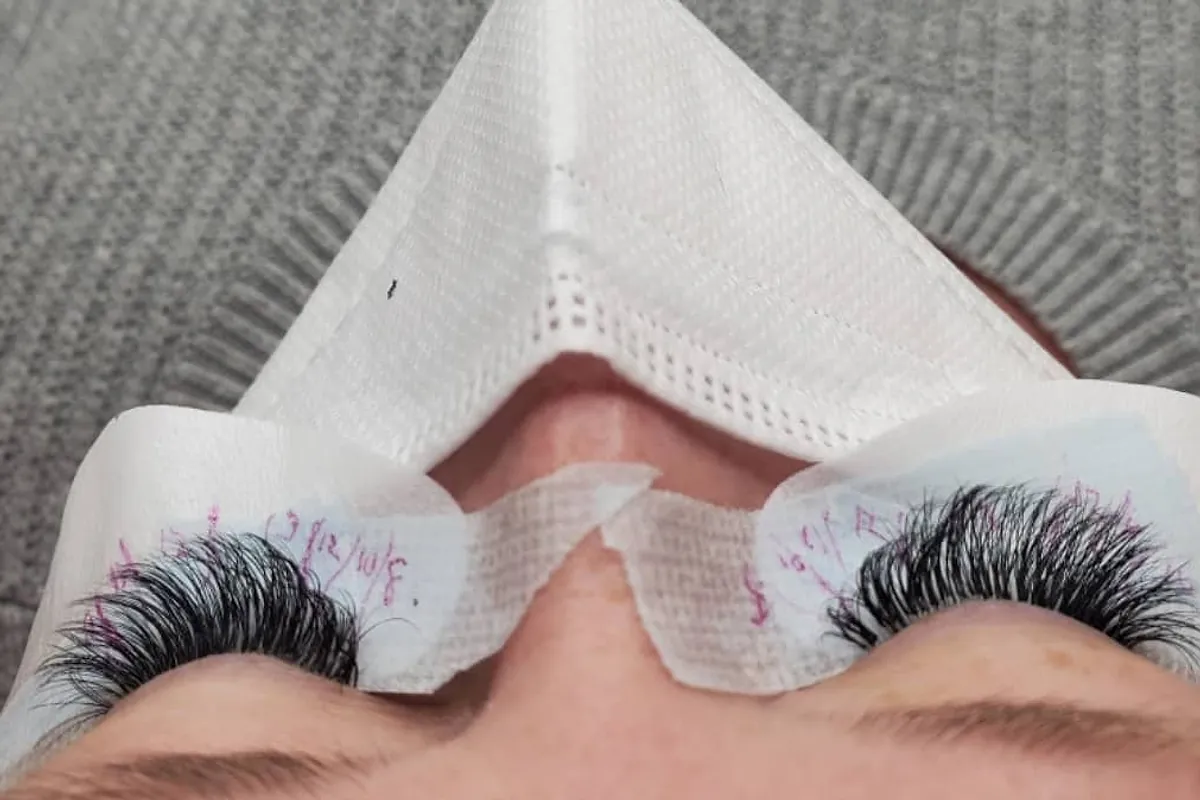
When buildup needs an in-studio clean, Desiree describes her Lash Bath this way:
Help those lashes get squeaky clean and boost your retention with this service.From Desiree’s menu: Lash Bath
Her menu language is studio guidance, not a controlled retention result. A lash bath can clean the lash line; the current research does not let this article promise how many extra days a set will last.
Quick answers
- Does oil dissolve lash-extension glue?
- This article cannot make that universal claim. Desiree recommends oil-free care, but the screened corpus has no direct human trial comparing ordinary oil products against extension retention. Adhesive and product formulas vary, so share the exact label and pattern instead of relying on the category alone.
- Can I use micellar water with lash extensions?
- Micellar water is not one formula. Check the exact product rather than the front-label category, and ask Desiree before using it at the lash line. Her current routine is an oil-free cleanser, gentle rinsing and patting rather than rubbing.
- Can eye cream make lash extensions fall out?
- A visible change after using eye cream does not prove the cream caused it. Record the exact formula, where you applied it, when you began and the fallout pattern. Keep cream off the lash line under Desiree's current aftercare and send her the comparison.
- Does a lash bath remove oil and improve retention?
- It can clean buildup at the lash line. Desiree describes her Lash Bath as a way to get "squeaky clean and boost your retention," alongside daily washing. That is her menu language. The Saudi Arabian survey describes washing behavior (Chiang et al., 2025); it did not test lash baths or quantify extension retention.

Who’s behind the answers
About the studio
Central Oasis is a lash and brow studio in Northeast Portland, led by Desiree, the lash and brow artist. Every service description in this diary quotes her own menu, word for word.
Book it
- Lash Bath$15 · 15 minutesBook Lash Bath (opens Square in a new tab)
- Classic Lash Fill (60 min)$55 · 60 minutesBook Classic Lash Fill (60 min) (opens Square in a new tab)
- Hybrid Lash Fill (90 min)$110 · 90 minutesBook Hybrid Lash Fill (90 min) (opens Square in a new tab)
Nothing is charged online; you pay at your visit.
Sources
- Dempsey JH, Fabula AM, Rabe TE, Lubbers JM, Ye M (2012). Development of a semi-permanent mascara technology. International Journal of Cosmetic Science.An adjacent mascara-materials study, not an extension-adhesive trial; it supports that one rosinate-polymer formula formed a flexible, abrasion-resistant film insoluble in soap and water.
- Watanabe K, Kakizawa E, Okuyama M (2016). Development of a Novel Flexible Film-forming Agent Derived from a Plant Wax and Its Application in Mascara. Journal of Society of Cosmetic Chemists of Japan.A Japanese mascara-formulation study, not an extension study; it supports only that the tested oil-based carnauba-wax formula improved mascara curl setting and retention.
- Chiang S, Chang S-H, Yao K-C, Kuo P-Y, Hsu C-T (2025). AIoT-Based Eyelash Extension Durability Evaluation Using LabVIEW Data Analysis. Sensors.A laboratory extension-durability study; it supports a non-linear compression result and did not test consumer oils, cleansers or eye creams.
Know someone with the same question?