What did the lash-retention laboratory study find?
The study used a controlled apparatus rather than people. In that model, extension durability decreased as temperature increased from 15 °C to 35 °C (Chiang et al., 2025). That is a real result inside the tested system. It is not a measured number of days that a Portland client will keep a set.
The compression result was less tidy. Retention was higher at 3000 cycles than at both 1000 and 5000 cycles (Chiang et al., 2025). A simple story—more contact always produces proportionally more loss—does not fit that result. The study gives us a reason to take mechanical conditions seriously and a reason not to invent a friction formula from them.
| Study input | Result inside the model | Public-use boundary |
|---|---|---|
| Temperature | Durability decreased from the lower to the higher tested temperature | Supports a heat-sensitive lab signal, not a client wear-time prediction |
| Repeated compression | The pattern was nonlinear across the tested cycle counts | Does not establish a per-rub, per-night or per-touch loss rate |
| Wind | It was part of the experimental setup | The screened public claim set does not provide a client-level wind rule or threshold |
Why can’t the lab result predict how long my set will last?
Control the inputs. A bench can set temperature and repeat compression under known conditions.
Measure the model. The output describes retention in that apparatus—not days of wear on a person.
Add the missing history. A real set needs matched images, timing, reported exposures and Desiree's review.
A bench model can hold selected conditions steady. A client cannot. Real wear includes the natural lash beneath each extension, application details, cleansing, products, symptoms, accidental contact and the timing of what changed. The complete natural eyelash life cycle ranges from 4 to 11 months (Aumond and Bitton, 2018), and individual lashes are not all at the same point in that cycle.
That biology matters because an extension can leave with a naturally shed lash or separate from it. The laboratory result does not sort those two outcomes in your bathroom, on your pillow or in a close-up. It also does not establish that one hot shower, one windy walk or one touch caused a visible gap.
What should I record when retention changes?
Record conditions while they are still easy to remember. Do not run a home experiment with extra heat, wind or rubbing. The goal is to give Desiree a better timeline while keeping several explanations open.
- Timing: appointment date, first day you noticed a change and whether it was sudden or gradual.
- Pattern: one eye or both, plus inner, center or outer zones.
- Environment: unusual heat, steam, wind or travel—recorded as context, not the cause.
- Contact: rubbing, pillow pressure, towels, eye masks or an accidental pull.
- Products and washing: what touched the lash line and how it was removed.
- Fallen pieces: whether a natural lash was attached, an extension appeared alone or you could not tell.
Hi Desiree, my appointment was on [date]. I first noticed [eye and zone] changing on [day]. Around then I had [heat, wind, contact, product or routine detail]. The pieces I saw [did/did not/I could not tell if they] had a natural lash attached. I have photos from [dates]. What would you like me to do next?
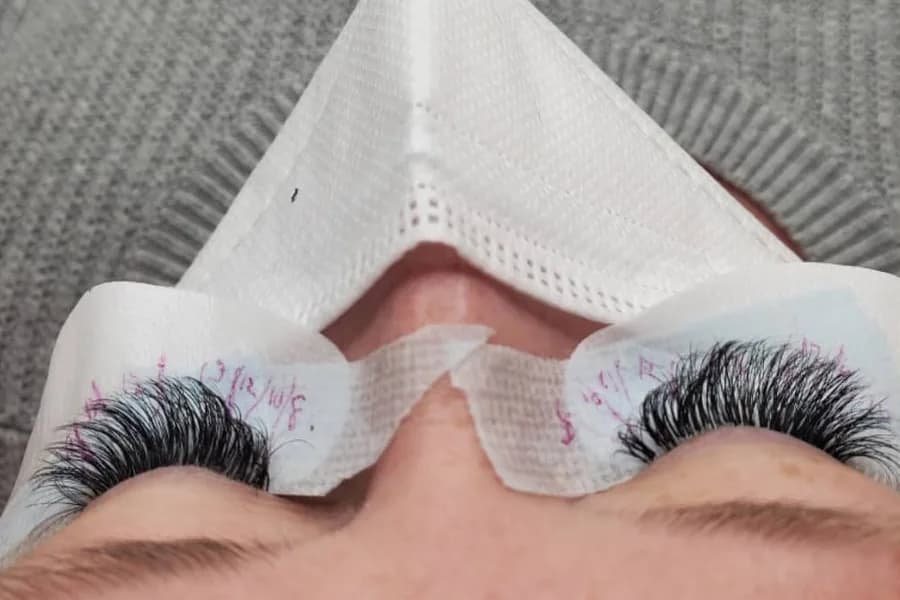
Can the Central Oasis camera tell whether heat or friction caused fallout?
No. A close-up can help describe what is visible now—such as a side-to-side or zone difference—but it cannot recover a temperature history, count overnight contact or identify why a bond changed. The camera should not label a pattern as heat damage, wind damage or friction damage.
The productive AI connection is narrower: standardize the views, preserve the user's timeline and bring the visible pattern together with reported context. The system can then retrieve the bounded research note and show its limits. Desiree still decides what the pattern means for the appointment. How the photo path works explains that handoff.
What should I do if my set is changing now?
Keep following Desiree's aftercare, avoid pulling or testing the set and send the timeline before choosing a fix. Why lash extensions do not last organizes the broader retention clues; why one eye can look thinner helps with a side-to-side pattern.
Redness, swelling, pain, discharge, light sensitivity or any vision change moves this out of routine retention troubleshooting. Contact Desiree and seek medical care for active symptoms; a lab study, blog post or photo cannot determine the cause.
Quick answers
- Does heat make lash extensions fall out faster?
- A 2025 laboratory model found lower extension durability as temperature increased from 15 °C to 35 °C (Chiang et al., 2025). It did not measure clients or convert temperature into days of wear. Record unusual heat as context, avoid direct heat on the lash line and ask Desiree about a changing set.
- Can wind make lash extensions fall out?
- Wind was one condition in the cited laboratory study, but the screened public claim set does not establish a real-client wind threshold or a number of lost lashes (Chiang et al., 2025). A windy day belongs in the timeline if it coincided with a change; it does not prove why the change happened.
- Does rubbing always cause proportionally more lash-extension loss?
- The cited apparatus used repeated compression rather than measuring a person rubbing an eye. Its compression result was nonlinear, so it cannot support a simple per-rub loss rule (Chiang et al., 2025). Avoid rubbing because it can disturb the lash line, but do not use the study to calculate damage from one event.
- Can a lash photo show heat or friction damage?
- No. A photo can document where a set looks lighter, whether one side differs and how the pattern changes between matched views. It cannot recover heat, wind or contact history or determine the cause. Report those conditions separately, and let Desiree combine the image with the timeline.

Who’s behind the answers
About the studio
Central Oasis is a lash and brow studio in Northeast Portland, led by Desiree, the lash and brow artist. Every service description in this diary quotes her own menu, word for word.
Book it
- Classic Lash Fill (60 min)$55 · 60 minutesBook Classic Lash Fill (60 min) (opens Square in a new tab)
- Hybrid Lash Fill (90 min)$110 · 90 minutesBook Hybrid Lash Fill (90 min) (opens Square in a new tab)
- Volume Lash Fill (90 min)$130 · 90 minutesBook Volume Lash Fill (90 min) (opens Square in a new tab)
Nothing is charged online; you pay at your visit.
Sources
- Chiang S, Chang S-H, Yao K-C, Kuo P-Y, Hsu C-T (2025). AIoT-Based Eyelash Extension Durability Evaluation Using LabVIEW Data Analysis. Sensors.A laboratory apparatus study, not a client wear-time study; it supports the 15 °C to 35 °C temperature finding and the nonlinear compression result only inside the tested model.
- Aumond S, Bitton E (2018). The eyelash follicle features and anomalies: A review. Journal of Optometry.A review of eyelash biology; it supports the 4-to-11-month complete natural-lash cycle, not a prediction of extension wear time or a cause of fallout.
Know someone with the same question?